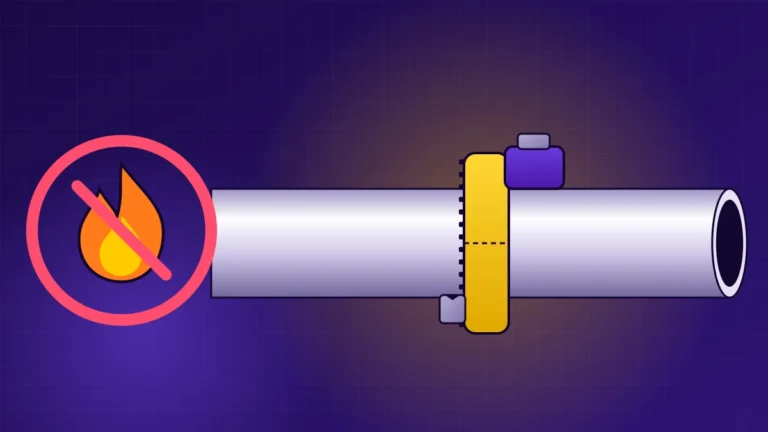
Both diamond wire saws and clamshell lathes are cold cutting methods: no flame, no heat-affected zone. But they work in very different ways and suit different jobs. This guide compares them so you can choose the right one for large-bore pipe, vessels and structures.
How a diamond wire saw works
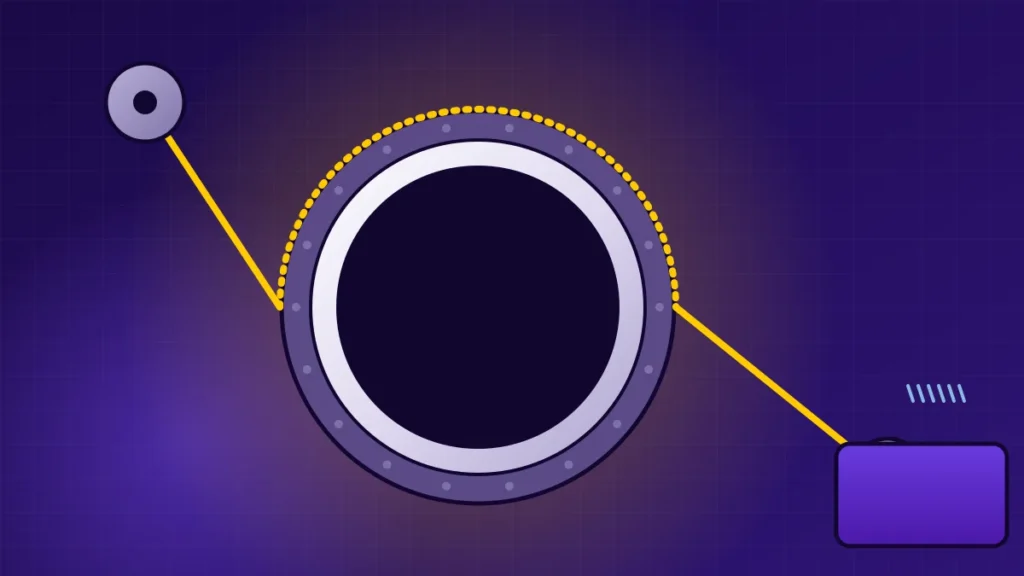
A diamond wire saw uses a loop of steel cable threaded with beads coated in industrial diamond. The wire runs around a set of pulleys at high speed and is pulled slowly through the material. Water cools the wire and carries away the cut material.
Because the wire just needs to loop around the work, it can cut:
- very large diameter pipe;
- pipe bundles and multi-layer structures;
- pipe with concrete coating;
- odd shapes, such as nozzles, risers and caissons;
- items under water, in offshore decommissioning.
How a clamshell lathe works
A clamshell or split-frame lathe clamps around the pipe and turns cutting tools around it. It produces a precise, square cut and can machine a weld bevel in the same set-up. Read more in our guide to clamshell pipe cutting.
Side-by-side comparison
| Factor | Diamond wire saw | Clamshell lathe |
|---|---|---|
| Best for | Very large, irregular or composite sections | Round pipe, from small bore to large diameter |
| Cut finish | Rougher, may need finishing | Clean, square, accurate |
| Weld bevel | No, a separate step is needed | Yes, in one set-up |
| Set-up | Pulleys and wire routing; flexible | Frame must fit the exact pipe size |
| Space needed | Wire path around the work | Radial clearance for the frame |
| Typical use | Decommissioning, demolition, large structures | Repairs, tie-ins, weld preparation |
Which should you choose?
Choose a clamshell lathe when:
- the pipe is round and within the tool range;
- the cut end will be welded and needs a bevel;
- accuracy and squareness matter.
Choose a diamond wire saw when:
- the item is very large or not round;
- there are multiple materials, such as concrete-coated pipe;
- the cut is for removal or demolition, not re-welding;
- access only allows a wire to be threaded around the item.
On many decommissioning and brownfield projects, both are used: a wire saw to remove the bulk section, then a clamshell to prepare the remaining pipe end for a new tie-in.
Safety points for both methods
- Plan for the weight of cut sections and how they will be lifted.
- Support both sides of the cut.
- Follow the plant’s isolation, purging and permit process. See cutting pipes in hazardous areas.
- Guard the wire path on wire saws, because a broken wire under tension is dangerous.
Frequently asked questions
Is diamond wire cutting really cold?
Yes. Water cooling keeps the cut cool and there is no flame. It is widely used in hazardous and offshore environments.
Can a diamond wire saw cut stainless and duplex?
Yes, with the right wire and settings.
Which is cheaper?
It depends on the job. For a standard pipe cut with a weld bevel, a clamshell is usually more cost-effective. For huge or complex sections, a wire saw can save days.
For help choosing the right method for your project, see our pipe cold cutting services in Ras Al Khair, NEOM and other cities, or contact our team.