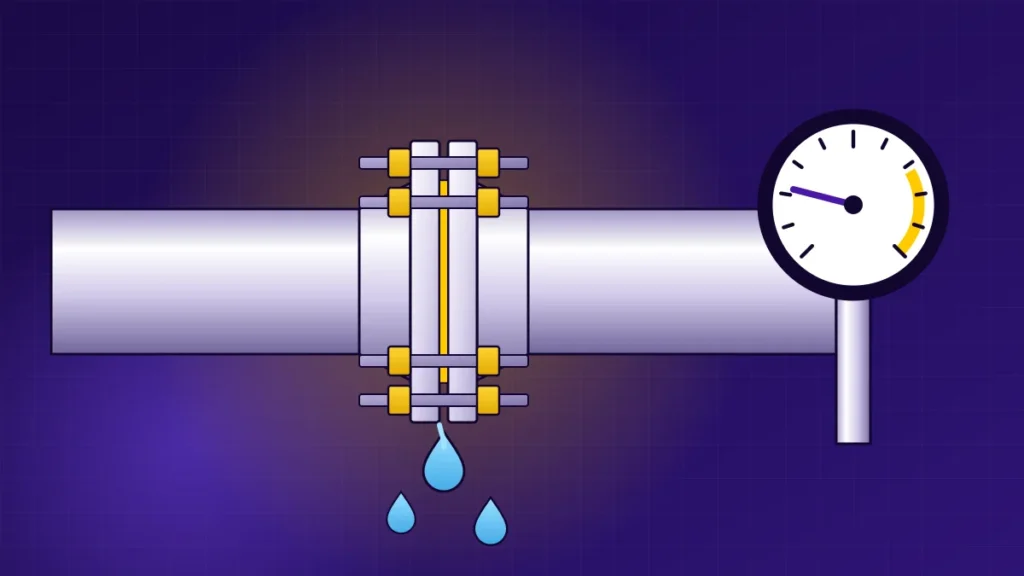
Few things are more frustrating than a flange that leaks on start-up after a turnaround. The unit is ready, the schedule is tight, and now a joint has to be isolated, drained and opened again. In most cases the leak was preventable. It is rarely bad luck; it is usually one of a small number of known causes.
Below are the seven causes we see most often on Saudi plant shutdowns, and what to do about each one.
1. Not enough bolt load (or uneven load)
The gasket needs a minimum stress to seal, and that stress has to stay high enough when the pipe is pressurised and heated. If the bolts were under-tightened, or some were tight and others loose, the gasket will not seal across its full face.
Typical signs: a leak at one part of the flange, often near the bolts that were tightened last or not checked on the final pass.
Fix: calculate a target bolt load for the joint (not a “standard torque”), use a proper star or alternative pattern, and finish with check passes until nuts stop turning. Our article on bolt torquing vs tensioning explains how each method controls load.
2. Wrong lubricant, or none
Torque only turns into bolt load if friction is known. Dry, rusty or dirty threads can absorb so much torque that the bolt gets half the load it should. Changing from one anti-seize to another can also change the result.
Fix: clean or replace studs and nuts, use the lubricant your torque values were calculated for, and apply it to the threads and the nut face.
3. Damaged or wrong flange face finish
Scratches across the face, pitting, corrosion under the old gasket, or a face that is too smooth or too rough for the gasket type will all leak. Radial scratches are the worst because they give a direct path across the seal.
Fix: inspect every face when the joint is open. Minor marks can be dressed; deeper damage needs on-site flange facing. The flange face finish guide lists the finishes that suit each gasket type.
4. Misalignment
If the two flanges do not line up, the bolts end up pulling the pipe into place instead of compressing the gasket. The gasket is crushed on one side and loose on the other. Common causes are pipe movement during the shutdown, removed supports, or spool pieces that were cut and re-welded.
Fix: check alignment before the gasket goes in. Flanges should come together by hand or with light pulling, not by forcing them with the bolts.
5. Wrong or reused gasket
A gasket that has been compressed once has lost much of its ability to recover. Reusing it, or picking the wrong material, thickness or pressure class, is a common cause of leaks.
Fix: always fit a new gasket that matches the line specification. Check spiral wound gaskets for the right inner ring, and handle them carefully so the windings are not damaged.
6. Thermal effects at start-up
When a hot line heats up, bolts and flanges expand at different rates. The bolt load can drop during the warm-up, and the gasket can relax. High temperature joints also lose load over time through creep.
Fix: use the right bolt and gasket materials for the temperature, and where the operator’s procedure allows, plan a hot torque check on critical joints after the line reaches temperature.
7. Tools and people
Uncalibrated torque wrenches, gauges that are out of date, wrong pump pressure conversions, and rushed crews all lead to the same result: bolts that are not at the load you think they are.
Fix: use calibrated tools with certificates, trained technicians, and a joint record for every flange. ASME PCC-1 gives a good framework for all of this.
How to find the cause of a leak
| What you see | Most likely cause |
|---|---|
| Leak at one spot on the circumference | Uneven bolt load, local face damage, misalignment |
| Leak all round the flange | Low bolt load overall, wrong gasket, lubricant problem |
| Leak starts after the line heats up | Thermal effects, gasket relaxation, bolt material |
| Leak comes back on the same joint after every shutdown | Face damage, design problem, misalignment |
| Leak at the gasket inner diameter | Gasket inner ring missing or damaged, face damage near the bore |
Preventing leaks on your next shutdown
The best way to avoid start-up leaks is to treat each flange as a controlled job, not a routine task:
- Make a joint register with every flange to be opened.
- Record gasket type, stud size, lubricant and target load for each one.
- Inspect faces and fix damage before closing.
- Use calibrated tools and a written tightening sequence.
- Tag every joint when it is finished and keep the record.
Our shutdown bolting checklist puts all of this on one page.
Frequently asked questions
Can I just tighten the bolts more to stop a leak?
Sometimes it helps for a short time, but it can also crush the gasket or overstress the bolts. It is better to find the cause. Live retorquing on a pressurised line is risky and should only be done under the operator’s procedures.
How often do joints leak after a turnaround?
It varies widely by plant. Plants that use a joint register, trained technicians and calculated bolt loads usually report far fewer leaks on start-up.
What is a hot torque?
A check tightening done after the line reaches operating temperature, to make up for the bolt load lost during heat-up. It must be done to an approved procedure.
If you are planning a shutdown in Al Jubail, Dammam or anywhere else in the Kingdom, our bolt torquing services cover the whole joint: inspection, facing, gasket fitting, tightening and records. Talk to our team.


