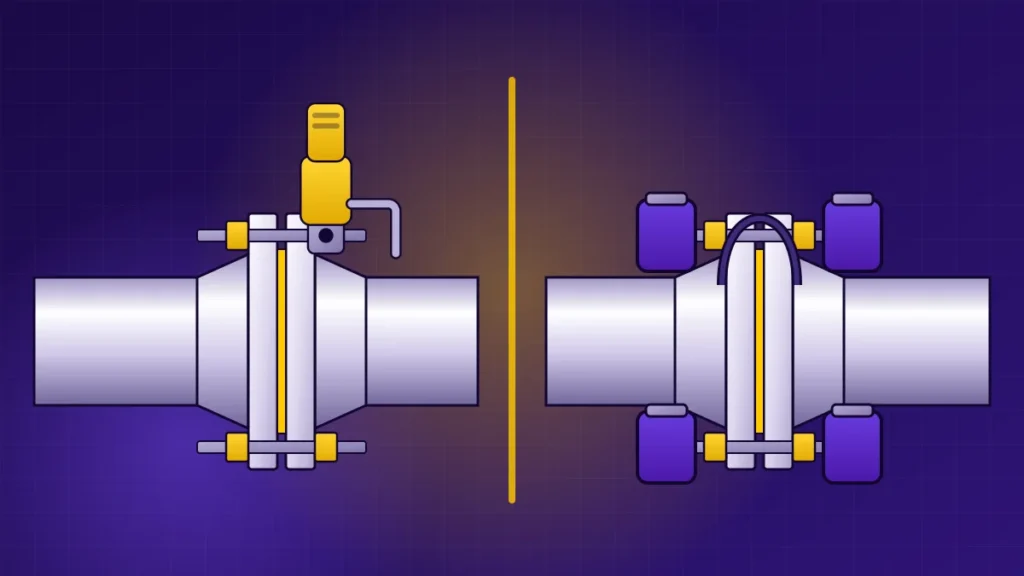
Bolt torquing and bolt tensioning both aim at the same result: the right clamping force in every stud of a flanged joint, so the gasket seals and stays sealed. The difference is how they get there. Torquing turns the nut against friction until a set torque is reached. Tensioning stretches the stud directly with a hydraulic tool, then the nut is run down by hand while the stud is held under load.
Neither method is “better” in every case. The right choice depends on the joint, the space around it, the stud length and how accurate the bolt load has to be. This guide explains both so you can choose with confidence, or ask the right questions of your bolt torquing contractor.
How bolt torquing works
A hydraulic or pneumatic torque wrench turns the nut. Most of the torque you apply is lost to friction: roughly 50% under the nut face and about 40% in the threads. Only around 10% actually stretches the bolt. That is why lubrication matters so much. The relationship is usually written as:
T = K × F × D
where T is torque, F is the bolt load you want, D is the nominal bolt diameter and K is the “nut factor”, which depends mainly on the lubricant. With a good anti-seize, K is often around 0.12 to 0.16. With dry or rusty threads it can be 0.20 or higher. Use the wrong K and the bolt load can be off by 30% or more, even if the torque reading is perfect.
Strengths of torquing
- Works on almost any bolt size and almost any joint.
- Needs no extra stud length.
- Tools are compact, especially low-profile hexagon cassette wrenches.
- Fast to set up and well understood by site crews.
Limits of torquing
- Accuracy depends on friction. Typical scatter in bolt load is ±20% to ±30%.
- Bolts are loaded one or a few at a time, so a tightening pattern and several passes are needed to even out the load.
How bolt tensioning works
A hydraulic tensioner fits over the stud and pulls on the thread that sticks out above the nut. The stud stretches, the operator turns the nut down until it is snug, then the pressure is released. Because friction plays no part in creating the load, tensioning is more consistent, typically ±10% or better.
There is one catch: when the pressure is released, some load is lost as the threads and nut settle. This is called load transfer loss, and it is allowed for by applying a higher pressure than the final target. The ratio depends on the stud length to diameter ratio, so the calculation must be done for each joint.
Strengths of tensioning
- More accurate and repeatable bolt load.
- Several studs (often 50% or 100% of them) can be tensioned at the same time with linked tools, which gives an even, parallel closure of the flange.
- No torsion in the stud.
Limits of tensioning
- Needs extra stud length, usually about one bolt diameter above the nut.
- Tools are bulky and need clearance around the flange.
- Not practical for small bolts, roughly below 3/4 inch or M20.
- Load transfer loss must be calculated correctly.
Side-by-side comparison
| Factor | Bolt torquing | Bolt tensioning |
|---|---|---|
| How load is created | Turning the nut against friction | Stretching the stud hydraulically |
| Typical bolt load accuracy | ±20% to ±30% | ±10% or better |
| Extra stud length needed | No | Yes, about 1 × diameter |
| Space needed around the joint | Low (cassette wrenches fit tight spaces) | Higher |
| Multiple studs at once | Usually 1 to 4 | 50% to 100% of studs |
| Best bolt sizes | Small to large | Large (about 1 inch and up) |
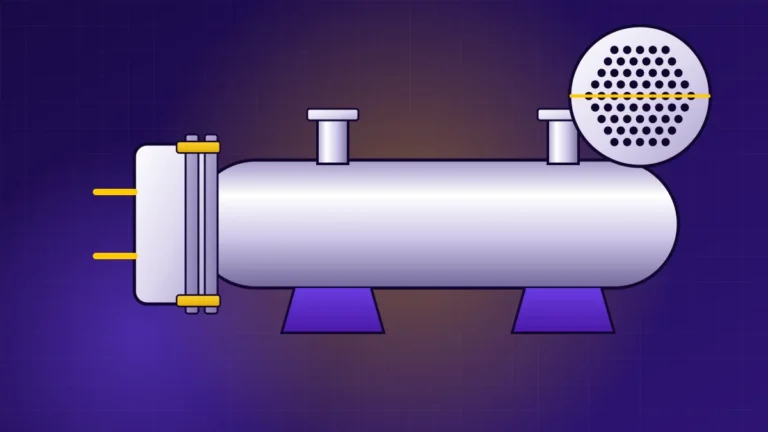
| Typical use | Most process flanges, pumps, valves | Heat exchangers, reactors, large high-pressure joints, wind and turbine bolting |
Which method should you choose?
Choose torquing when:
- The flange is small to medium size and the service is not critical.
- Studs are not long enough for tensioners, or space is tight.
- You need a quick, flexible crew on a shutdown with many different joints.
Choose tensioning when:
- The joint is large, high pressure or high temperature, and has a history of leaks.
- An even, parallel closure matters, for example on heat exchanger girth flanges or reactor heads.
- Studs were designed with extra length for tensioners.
Many plants in Jubail, Yanbu and Ras Tanura use both. A typical shutdown scope will torque most process flanges and tension a short list of critical joints. Whichever method you use, the work should follow ASME PCC-1, with calculated target loads, correct lubricant and a recorded tightening sequence.
Accuracy is about more than the tool
Even the best tool will not save a joint if the basics are wrong. Most bolted joint leaks come from:
- damaged or wrongly finished flange faces (see our flange face finish guide);
- the wrong gasket, or a reused gasket;
- poor alignment that the bolts are forced to pull out;
- no lubricant, or the wrong one;
- skipped passes or a wrong tightening pattern.
Our article on why flanges leak after a shutdown covers these causes in detail.
Frequently asked questions
Is tensioning always more accurate than torquing?
Usually, but only if load transfer loss is calculated correctly and the tools are calibrated. A well-run torquing job with a known lubricant and calibrated wrenches can be very good on most process joints.
Can I tension a joint that was designed for torquing?
Only if the studs are long enough and there is room for the tool. Often the studs must be replaced with longer ones first.
Do I need certified technicians for either method?
Many Saudi operators ask for bolting technicians trained to ASME PCC-1 Appendix A or an equivalent scheme. It is good practice for both methods.
What records should I get after the job?
At least the joint ID, gasket and stud details, lubricant, target torque or pressure, tool serial numbers and calibration dates, pass sequence, and the technician’s sign-off.
Need a bolting crew for your next shutdown? Our teams handle both torquing and tensioning across the Kingdom, including Al Jubail, Yanbu and Ras Tanura. Contact us for a quote.