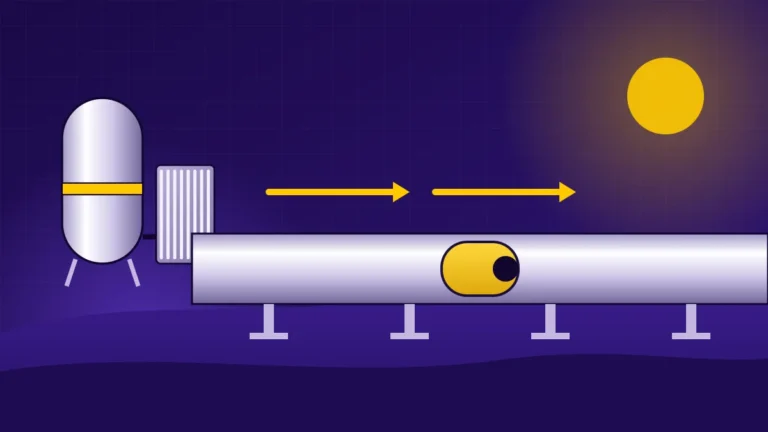
Ordering too little nitrogen stops a purge halfway. Ordering far too much wastes money and trailer space. This guide shows how to estimate the nitrogen a purge needs, with worked examples. Use these as planning estimates; your purging contractor should confirm the final figures.
Step 1: Work out the system volume
For a pipe:
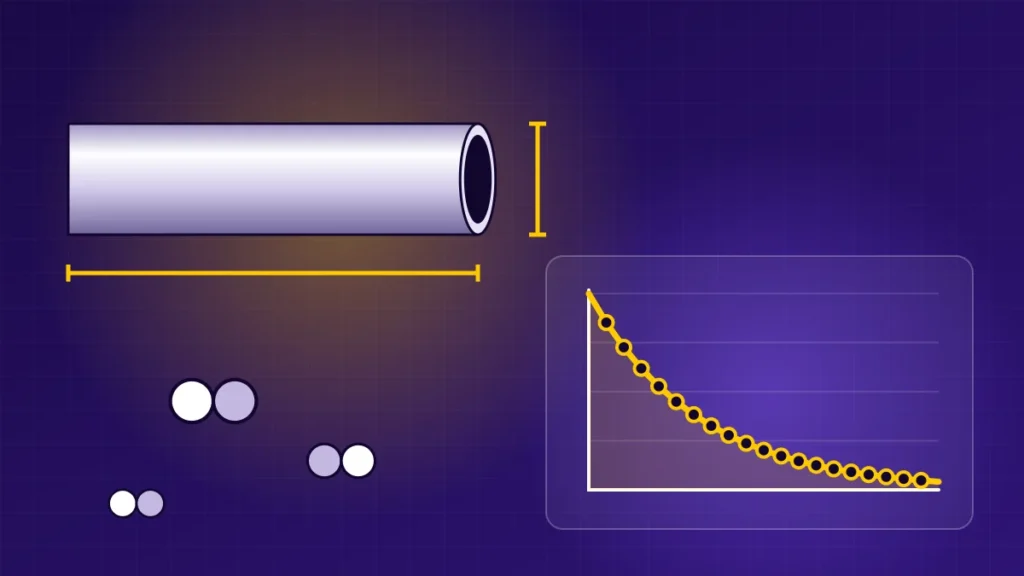
V = π ÷ 4 × D² × L
where D is the internal diameter and L the length, both in metres. V is in cubic metres (m³).
Example: 10 km of 12-inch pipe with an internal diameter of about 0.305 m:
V = 0.785 × 0.305² × 10,000 ≈ 731 m³
For vessels, use the vessel’s internal volume from the datasheet. Add the volume of connected piping, exchangers and dead legs.
Step 2: Choose the method and number of volumes
Dilution (sweep) purging
When nitrogen flows through and mixes with the gas inside, the oxygen level falls roughly as:
C = C₀ × e^(−n)
where C₀ is the starting oxygen level (21% for air), C is the final level, and n is the number of system volumes of nitrogen passed through.
| Target oxygen | Volumes needed in theory |
|---|---|
| 5% | about 1.4 |
| 2% | about 2.4 |
| 1% | about 3.0 |
| 0.5% | about 3.7 |
Real systems do not mix perfectly. Dead legs and poor flow paths slow the purge, so planners usually allow a safety margin on top of these figures.
Displacement (plug flow) purging
In a long pipeline, nitrogen pushed behind a pig or at a good velocity acts more like a piston. The purge can take close to one system volume plus an allowance for mixing at the interface, often around 1.2–1.5 volumes in planning.
Pressure cycle purging
Each cycle pressurises the system with nitrogen, then vents it back down. The oxygen level after k cycles is roughly:
C = C₀ × (P_low ÷ P_high)^k
using absolute pressures.
Example: pressurise to 2 barg (3 bar absolute), vent to atmospheric (1 bar absolute). Each cycle cuts oxygen to one third:
| Cycles | Oxygen |
|---|---|
| 1 | 7% |
| 2 | 2.3% |
| 3 | 0.78% |
| 4 | 0.26% |
Each cycle uses about (P_high − P_low) ÷ 1 bar × V of nitrogen at standard conditions, so in this example, 2 × V per cycle.
Step 3: Convert to nitrogen supply
Nitrogen is often delivered as liquid. One litre of liquid nitrogen gives roughly 0.7 m³ of gas at normal conditions (an expansion ratio of about 1:700, varying slightly with conditions).
Worked example: dilution purge of the 731 m³ pipeline to below 1% oxygen, with 3 volumes plus a 30% margin:
731 × 3 × 1.3 ≈ 2,850 m³ of nitrogen gas
2,850 ÷ 0.7 ≈ 4,070 litres of liquid nitrogen, before allowing for losses in the tank and vaporiser.
If the line also has to be packed with nitrogen at pressure afterwards, add the packing volume: V × (packing pressure in bar absolute − 1).
Step 4: Check the flow rate
The time a purge takes depends on the flow rate. For displacement purging of pipelines, the velocity should be high enough to avoid gas layering but within the limits set by the operator. Your contractor will match vaporiser or membrane capacity to the flow you need.
Frequently asked questions
Why do real purges need more nitrogen than the formula?
Because of dead legs, uneven flow, leaking valves and venting losses. Sampling at every vent point tells you when the purge is actually complete.
Is liquid or membrane nitrogen better?
Liquid nitrogen gives high flow rates and very pure nitrogen. Membrane units produce nitrogen on site from air, with lower purity and flow. The choice depends on volume, purity and location.
What about drying?
Drying needs a lot more gas than purging, because you are removing water, not just oxygen. See purging vs drying vs leak testing.
For a full purge plan, see our nitrogen purging procedure or our nitrogen purging services in Dammam, Yanbu and Jazan. Contact us for a calculation for your system.