The surface of a flange face is not meant to be mirror smooth. For most soft and semi-metallic gaskets it needs a controlled roughness, a pattern of fine grooves that the gasket can bite into. Too smooth, and the gasket can slide out under pressure. Too rough, and leak paths stay open. This guide explains what the numbers mean and how to choose the right finish.
What is Ra?
Ra (roughness average) is the average height of the surface peaks and valleys, measured along a line. It is given in micrometres (µm) or microinches (µin). 1 µm is about 40 µin.
Finishes are usually checked on site with a surface comparator (a set of reference samples you compare by touch and sight) or a portable profilometer for an exact reading.
Types of flange face finish
| Finish | What it looks like | Typical Ra |
|---|---|---|
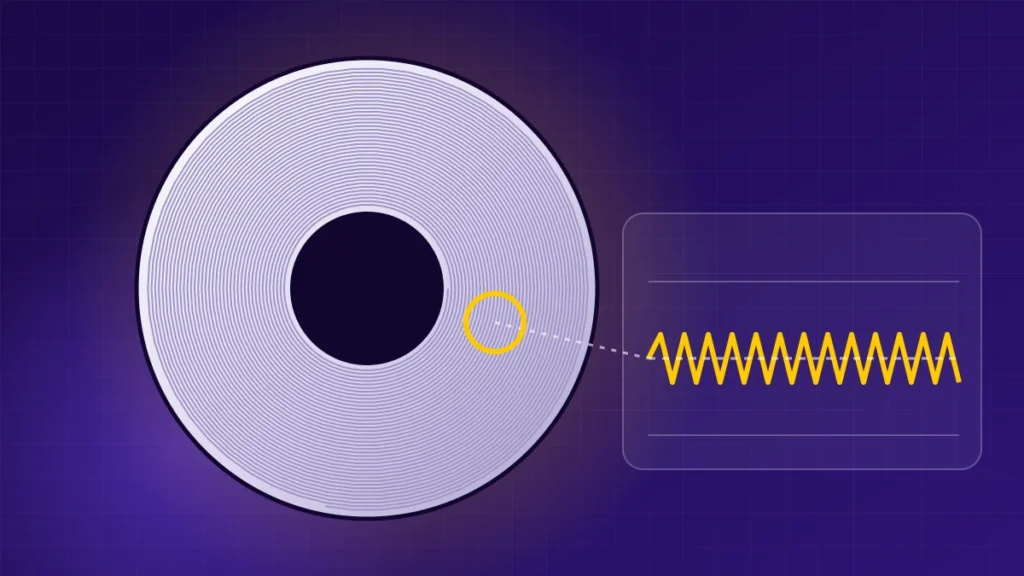
| Stock finish (serrated spiral) | A continuous spiral groove made by a round-nosed tool | 3.2–6.3 µm (125–250 µin) |
| Serrated concentric | Separate rings, not a spiral | 3.2–6.3 µm (125–250 µin) |
| Smooth finish | Fine tool marks, no visible serrations | Below about 3.2 µm (125 µin) |
| RTJ groove | A machined groove for a metal ring | Groove side walls 1.6 µm (63 µin) max |
For ASME B16.5 raised face flanges, the standard finish is a serrated finish with an Ra of 3.2–6.3 µm, produced with a round-nosed tool, typically giving around 45–55 grooves per inch. A concentric serration is often preferred for some gasket types because a spiral can, in theory, leave a continuous path from inside to outside.
Which finish for which gasket?
| Gasket type | Usual finish | Notes |
|---|---|---|
| Spiral wound | 3.2–6.3 µm (125–250 µin) | The most common combination in process plants |
| Compressed fibre / sheet | 3.2–6.3 µm (125–250 µin) | Serrations help grip and prevent blow-out |
| PTFE-based | Often 3.2–6.3 µm | Check the maker’s data |
| Kammprofile | Often 3.2–6.3 µm | Facing layers fill the surface; check maker’s data |
| Metal jacketed | Smoother, often 3.2 µm (125 µin) or less | Hard surface needs a finer finish |
| Ring type joint (RTJ) | Groove walls 1.6 µm (63 µin) max | Metal-to-metal seal; see RTJ groove repair |
Always check the gasket maker’s recommendations, because they vary by product.
Damage that matters
Even a correct finish can be ruined by damage. When you inspect an opened joint, look for:
- Radial scratches: marks running from the bore to the outside edge. These are the most serious, because they create a direct leak path.
- Pitting and corrosion, especially under the old gasket.
- Gasket burn-in or embedded gasket material.
- Dents and tool marks from bolts, spanners or handling.
- Warping or non-flat faces, often after welding or heat.
ASME PCC-1 gives acceptance limits for scratches and flatness depending on the gasket type. If damage is outside the limits, the face needs flange facing to restore it.
Restoring the finish on site
A portable flange facing machine mounts on the flange (inside the bore or on the outside) and machines the face in place. It can:
- re-cut a serrated spiral finish to the right Ra and groove pitch;
- produce a smooth finish for metal gaskets;
- re-machine RTJ grooves;
- correct flatness.
Machining removes metal, so the remaining thickness must be checked against the flange design. Our article on flange facing vs replacing the flange explains how to decide.
Frequently asked questions
Can I just polish out a scratch?
Light marks can sometimes be dressed by hand, within the limits allowed. Deeper radial scratches should be machined, because hand polishing can leave the face uneven.
Is a smoother face always better?
No. For most soft and spiral wound gaskets, a face that is too smooth gives the gasket nothing to grip.
How do I check the finish on site?
Use a surface comparator or a portable profilometer, and check flatness with a straight edge or a laser where needed.
Damaged faces are one of the main reasons flanges leak after a shutdown. Our flange facing services restore faces on site in Al Jubail, Jeddah, Yanbu and beyond. Contact us.